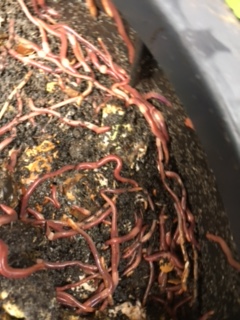
For the last few days, I’ve been deep into Donna Haraway’s Staying with the Trouble: Making Kin in the Chthulucene and I’ve been excited by how she revels in the “wormy pile” that is compost (32). I like to imagine that she would feel a-kin to the squirmy companion critters in our compost bin—even if worms don’t actually loom large in her writing. Speaking of compost, I love how in this book Haraway proposes compost and companions as more congenial figures for kin relations with critters than posthumanism. I’ve never really warmed to posthumanism myself, preferring new materialism and the more-than-human (if we want to bring human into the fore/background) and now I’m thinking about how Haraway’s ‘com’ figures also evoke the with-ness of kinships.
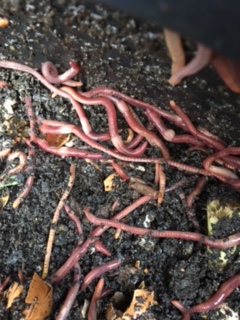
So I decided I needed to go back to Haraway’s earlier book, When Species Meet, where she digs into the roots of companion and finds cum panis–with bread (17). This reminder of how breaking bread and eating together lie at the heart of companionship makes me notice how our worms, companion-critters, eat with us. As I put my breakfast makings and leavings into the worm café and compost bin, I realize that it’s not just that we are feeding the worms but that they are actually eating what we eat—we are all eating the same food, drinking the same drinks (yes, an incredible amount of coffee and tea and quite a lot of toast, speaking of panis). A moveable, shared, companionable vegetarian feast.
As I drink my/our morning coffee and munch my/our toast, I remember, too, that Darwin also recognized worms’ companionability, their sociability: “They perhaps have a trace of social feeling, for they are not disturbed by crawling over each other’s bodies, and they sometimes lie in contact” (15). Or, as Donna Haraway might put it, “entangled meaningful bodies” (26).
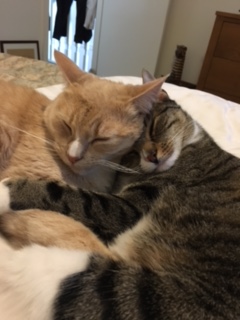
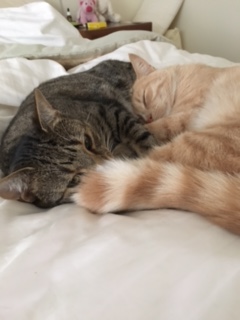
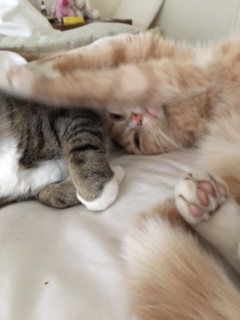
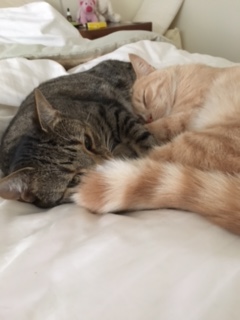
Ok, I can’t resist bringing Z&Z into this conversation. Again, they are still in bed upstairs while we’re all having breakfast downstairs and outside (yes it’s still wintry cold here). But as ever, Ziggy and Zazie are part of this assemblage and have a lot to say about companionable entanglements.
In an earlier post, I was thinking about how Haraway reacted to Deleuze and Guattari’s ‘becoming-animal.’ It’s not that she rejects becoming, it’s just that for her what matters is real worldling becoming with. And the care and curiosity this involves. In When Species Meet, she talks about “practices of care” (90) that shape all the critters in the relationship—and the need to “act in companion species webs with complexity, care and curiosity” (106). Her com or with figures resonate with Vinciane Despret. As I’ve been reading their books together–and together with the worms–I’ve loved how they write with a certain attuned entanglement with each other and with animals—sharing interests and concerns and questions and surprises: “Emphasizing that articulating bodies to each other is always a political question about collective lives, Despret studies those practices in which animals and people become available to each other, become attuned to each other, in such a way that both parties become more interesting to each other, more open to surprises, smarter, more ‘polite,’ move inventive… partners learn to be ‘affected’; they become ‘available to events’; they engage in a relationship that ‘discloses perplexity.’” (207)
Lots to chew on there! Before I finish my last coffee and piece of toast—spoiler alert—I want to mention some more com relations, that I’ll add to the compost of my next post where I want to think about the complex kinship of working with worms in an art project as collaborators, colluders, contrivers.
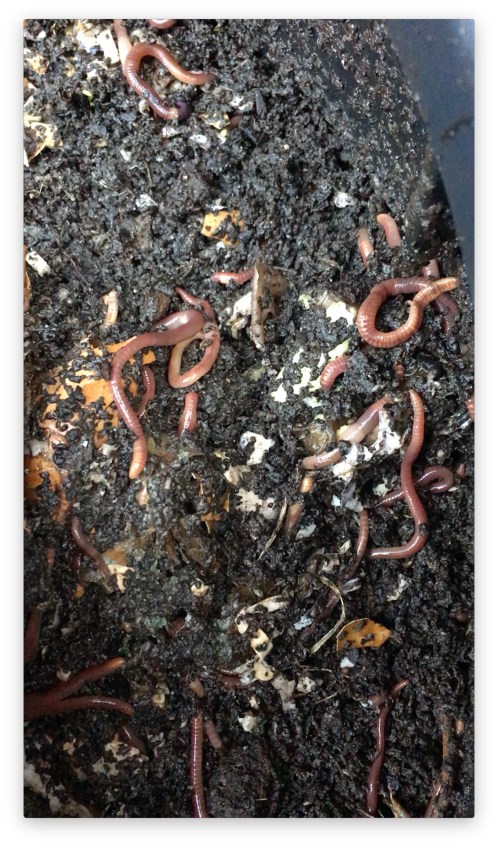




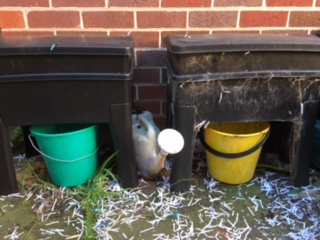

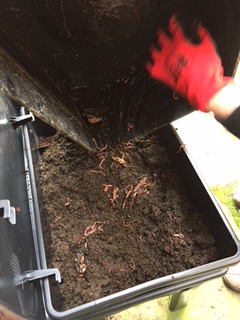
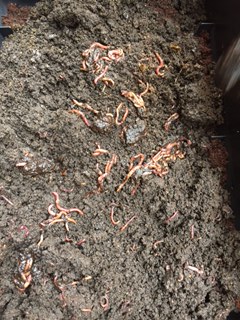
 Coffee cup in hand, I give the critters an early morning gift from the local organic shop — a bag full of coffee grinds to enliven the carrots and apples. I wonder if it will wake them up and move them with joy on this very cold morning? Guess I won’t know til tomorrow, when I see if they’ve been lured out of bed and made the big journey through the blanket and shreds. Meanwhile I did help a couple up of worms to wake up and smell the coffee — to see if they might let the others know the delights in store for getting out of bed. Hope they don’t mind. Not sure who is slower today, me or them, but it’s beginning to work on me…
 .
.
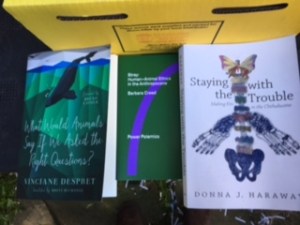 Three books for the beginnings of this project. Difficult to decide where to start but Vinciane Despret is calling the most insistently. What Would Animals Say If We Asked the Right Questions? How can I resist her first chapter, “A For Artist: stupid like a painter?” The challenge is not to quote every provocative and enchanting sentence. Like this one “But above all, this enchantment arises by the grace of the attunement between living beings” as animals and people work together. “No single response has the power to sanction the meaning of what is happening, and this very uncertainty, which is similar to that which we witness in a a display of magic, is part of what makes us sensitive to its grace and enchantment.” (4)
 Working with Worms